
When power cuts happen, should you still trust your purifier?

If you live in a city where power cuts are as common as evening tea, you already know the small inconveniences they bring like stopping chores, dark rooms, and sometimes, no purified water when you need it most. For many Indian households, this raises a simple but important question: Can your water purifier still protect your family during an outage?
This is where understanding the difference between electric and non-electric water purifiers becomes essential.
How do electric water purifiers function during power cuts?
Electric purifiers, such as RO (Reverse Osmosis) or UV (Ultraviolet) systems, rely on electricity to function. These technologies use electrical power to run their internal pumps and UV lamps. RO systems need pressure to push water through semi-permeable membranes, while UV models use a lamp to kill bacteria and viruses.
When power fails, both these components stop working temporarily, pausing the purification process. If your purifier has a storage tank, you can still access the previously purified water. But once the stored supply runs out, the system won’t produce fresh purified water until the power returns.
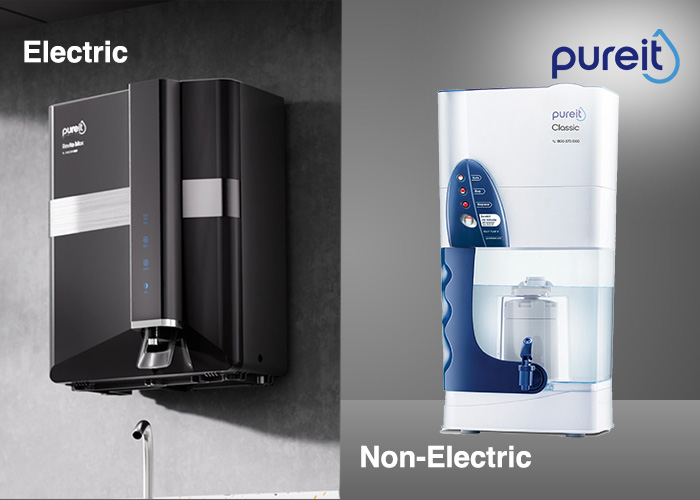
That’s why many modern models, like the Pureit Revito Prime, come with a large 8-litre tank and in-tank UV sterilization that keeps water safe even during long outages. So, while the unit can’t purify new water without power, it ensures the water already stored remains fresh, clean, and free from contamination.
How non-electric water purifiers work?
Non-electric water purifiers operate without electricity, making them a reliable option for areas with frequent or long power cuts. These purifiers typically use gravity-based or mechanical filtration, allowing water to pass through activated carbon and microfiltration layers using natural pressure.
Unlike their electric counterparts, they don’t rely on UV lamps or RO membranes. Instead, they physically remove visible impurities like dust, sand, and chlorine, and often reduce odour and taste issues.
However, it’s important to note that non-electric water purifiers may not remove dissolved salts or heavy metals, which can be present in groundwater or mixed water supplies. That’s why they are best suited for regions where water comes from relatively clean municipal sources.
The Pureit Classic 23-litre non electric water purifier, for example, uses a multi-stage gravity filtration system that provides up to 9 litres of purified water at a time, ideal for families living in areas with good-quality tap water but unreliable electricity. It requires no power, no running water pressure, and is easy to maintain, making it a dependable backup option or even a primary choice for households with a consistent municipal supply.
The right purifier depends on your water source, family size, and power availability. For many Indian homes, a non-electric water purifier acts as an excellent backup, especially during festive months or summer seasons when outages are frequent.
Conclusion
Power cuts may disrupt your routine, but they shouldn’t disrupt your access to clean drinking water. The smart choice is not about choosing only one type of purifier, and it’s about ensuring your home is prepared for every situation.
So whether you rely on electricity-driven RO systems or a gravity-based non-electric water purifier, Pureit ensures that every sip stays pure, safe, and worry-free, no matter what’s happening outside.